
Most companies eventually reach a point where the team they need is larger than the team they can hire in one place.
Sometimes the driver is cost. Sometimes it is the need to support customers in new markets. Sometimes the local hiring market is simply tapped out, and the company is growing too quickly to keep waiting for the perfect candidates within commuting distance of headquarters.
Whatever the reason, the conversation often starts in a deceptively simple place: "Should we open another development center?" Or, "Should we move some engineering offshore?"
Those are the wrong first questions.
Geographic expansion is not primarily a real estate decision, a recruiting decision, or a cost-reduction decision. It is an operating model decision. The moment you split product development across locations, you change how strategy gets communicated, how customer understanding travels, how decisions get made, how tradeoffs get resolved, and how teams build trust.
That does not mean geographic expansion is a mistake. For any company beyond early startup phase, it is necessary. It may even be one of the most important moves they make as they scale. But it needs to be treated with the same care you would bring to a major product strategy decision, because that is what it is. You are deciding how the organization will convert customer insight into shipped product across time zones, cultures, and reporting lines.
No amount of product process can fully compensate for the wrong operating setup. Strong rituals help. Good artifacts help. Clear strategy helps a lot. But if the structure itself fights the work, every sprint, roadmap review, product discovery effort, and executive alignment session will carry extra friction.
Before expanding geographically - whether regionally, nationally, or internationally - there are six questions worth answering. These are not casual topics to be handled in side conversations during annual planning. These questions should shape the operating model before hiring starts.
1. What Strategic Driver Underpins the Expansion?
Geographical expansion introduces immediate operational overhead. For the investment to yield returns, the strategic objective must be explicit. Distributed teams generally scale to solve one of five core operational challenges:
- Financial leverage: Reducing the fully burdened cost per employee to maximize runway or expand R&D capacity within fixed budgetary constraints.
- Resource availability: Bypassing local talent shortages where competition has inflated acquisition costs or exhausted the regional specialized pool.
- Domain or technical specialization: Anchoring a team in a region known for concentrated technical expertise, such as cybersecurity in Tel Aviv or deep machine learning clusters in specific global research hubs.
- Temporal coverage: Establishing a continuous development and operational cycle by distributing product teams across complementary time zones.
- Market proximity: Placing product and development personnel inside a critical geographic expansion market to ensure local user nuances and regulatory requirements inform the product directly.
Most organizations discover that their motivation spans a combination of these drivers. Misalignment occurs when different parts of leadership prioritize different outcomes. If the finance organization expects pure cost mitigation while product leadership prioritizes specialized machine learning talent, the choice of location and the resulting culture will pull the organization in opposing directions. Clear, documented consensus on the primary objective is required before evaluating specific regions. Always start with the "why are we doing this question."
2. Where Will the Lines of Separation Fall?
Geography introduces two distinct vectors of friction: the distance between your product team and your customers, and the distance between the members of your product team.
When development staff sits thousands of miles from the primary market, customer empathy erodes. Builders lose the intuitive understanding of user frustration that comes from routine proximity. Similarly, separating the core product triad—product management, design, and engineering—strains the mechanics of iterative development. Innovation thrives on the immediate feedback loop between technical feasibility, user desirability, and business viability.
By analyzing how these distances interact, we can map out five distinct organizational frameworks. Each carries specific trade-offs.
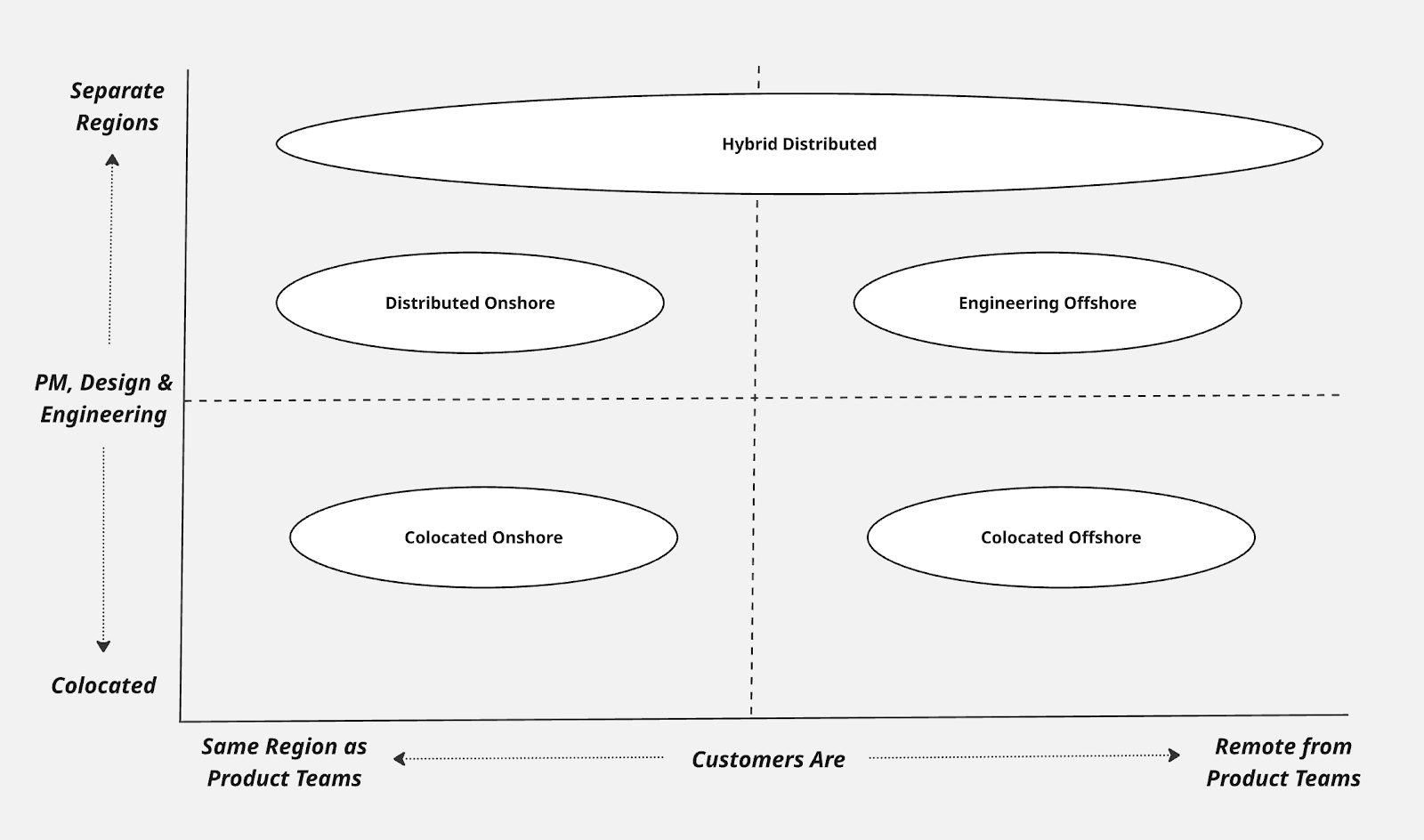
Colocated Onshore
All product managers, designers, and engineers sit in the same physical space, within the primary market country.
- The Reality: This approach eliminates structural communication lag. It provides the highest baseline for collaborative innovation and discovery. However, it severely restricts your talent pool to a single commuting radius and represents the most expensive talent acquisition model. It is an ideal setup for early-stage product discovery where a team must pivot rapidly to find product-market fit.
Distributed Onshore
The team remains within the same country and across manageable time zones, but operates out of separate regional hubs or remote offices.
- The Reality: This model maintains shared cultural context and allows for straightforward domestic travel for research and workshops. It widens the talent pool significantly while keeping compensation frameworks relatively uniform. Cost optimization is minimal, but operational complexity remains low.
Engineering Offshore
Product management and design remain close to the primary market, while the entire engineering engine sits multiple time zones away.
- The Reality: This structure generally delivers substantial financial leverage and opens access to massive talent pools. The risk lies in the degradation of the product-to-engineering feedback loop. If managed poorly, engineering becomes a transactional execution layer rather than a strategic partner. This model functions best for mature, stable product lines with well-understood architectures and clear roadmaps, rather than highly speculative initiatives requiring constant strategic pivots.
Co-located Offshore
An entire self-contained product line team—including product management, design, and engineering—is established together in an international tech hub, while the executive team and go-to-market functions remain in the home market.
- The Reality: This preserves the integrity of the core triad, allowing for high-velocity local execution. The challenge shifts to customer distance; a product manager in an offshore center can easily lose touch with the realities of an onshore customer base. Without a rigorous mechanism designed to bring customer insights to this team, they risk building highly optimized software that misses the market need.
Distributed Hybrid
A combination of the above models, typically emerging organically as a mid-stage company scales.
- The Reality: While hybrid models offer ultimate talent acquisition flexibility, they introduce immense operational randomness if left unmanaged. If every individual Agile team becomes a unique mosaic of four different time zones and multiple tools & processes, systemic coordination friction will slow delivery to a crawl. The hybrid model must be governed by a strict architecture: individual product lines or platform domains should adhere to one of the consistent models above, functioning as self-contained units to prevent fragmentation at the team level.
3. Which Segments of the Portfolio Should Move?
Expanding your footprint does not mean moving your entire product organization simultaneously. Successful expansion relies on a deliberate partitioning of the product portfolio based on strategic risk and maturity. This is important for any distributed team, but especially critical when considering international expansion.
The "Toe-in-the-Water" Approach
This tactical entry point moves maintenance engineering, technical debt remediation, or minor incremental updates for an established product line to a new region. This isolates the core onshore team from operational maintenance, freeing them to focus on foundational architecture or next-generation products.
The underlying challenge here is retention. Top-tier global engineers rarely stay long in roles limited exclusively to legacy upkeep. Additionally, if the system under maintenance represents your highest-revenue legacy engine, operational errors caused by a disconnected team can directly impact customer retention.
Full-Stack Product Line Co-location
This strategy assigns an entire strategic domain or standalone product line to the expansion site. The international team owns the lifecycle of that domain, containing its own product management, design, and engineering talent.
This model requires well-bounded problem spaces where architectural dependencies on the home team are minimized. It also demands a senior onshore product leadership function capable of setting long-term strategic boundaries without micromanaging daily execution.
Full-Stack Product Portfolio Co-location
The most aggressive operational state, where multiple strategic product lines—including core innovation horizons—run completely from offshore center(s).
Attempting this on day one regularly results in operational failure. Organizations that successfully run an "all-in" international portfolio almost universally scale up to it, proving the operational mechanics on a single product line before replicating the blueprint across the wider organization.
The two full-stack models provide the most leverage, but are often the trickiest to execute.
4. What Governance and Ownership Structure Best Serves the Business?
The employment mechanism dictates your level of control, compliance exposure, and long-term cost structures. The operational spectrum runs from absolute asset ownership to pure capacity outsourcing.
Employer of Record (EOR)
A third-party platform legally employs your distributed talent on your behalf. This bypasses the burden and duration of setting up entities, allowing you to hire international talent within weeks. The downside is a premium service fee layered on top of gross employment costs, along with a minor systemic barrier to full cultural alignment, since employees technically sign contracts with a third-party platform.
Build-Operate-Transfer (BOT)
Partnering with a specialized local operator to stand up a dedicated development organization under their legal umbrella. The partner manages recruiting, infrastructure, and local administration under a transparent "cost-plus" pricing structure. After a predetermined period, you exercise an option to transfer the legal entities and employees entirely to your corporate asset portfolio.
- The Trade-off: BOT mitigates early compliance and operational risk while preserving a clear path to full long-term asset ownership. It requires an active management presence to ensure the vendor builds a culture that aligns with your home organization rather than their own.
Traditional Capacity Augmentation (Rate Card Vendors)
Procuring engineering velocity via a professional services firm or systems integrator on a time-and-materials basis.
- The Trade-off: This offers rapid scalability and straightforward contractual termination parameters. The significant risk is the transactional nature of the talent pool. You rarely have transparency into internal compensation or employee motivation, leading to high turn-rates and a systemic loss of institutional product knowledge over time.
For core product development, a model featuring dedicated, badged talent—whether through a captive center, an EOR framework, or a specialized international staffing partner—is fundamentally preferable. Software creation is an exercise in context accumulation; outsourcing it as a disposable commodity frequently compromises the architectural integrity of the platform.
5. How Will the Selection Process Be Managed?
Selecting an expansion destination and an operational partner requires an analytical evaluation framework. Rushing this sequence routinely locks an organization into a region or partnership mismatch that takes years to unravel. A disciplined selection tracks through three operational gates:
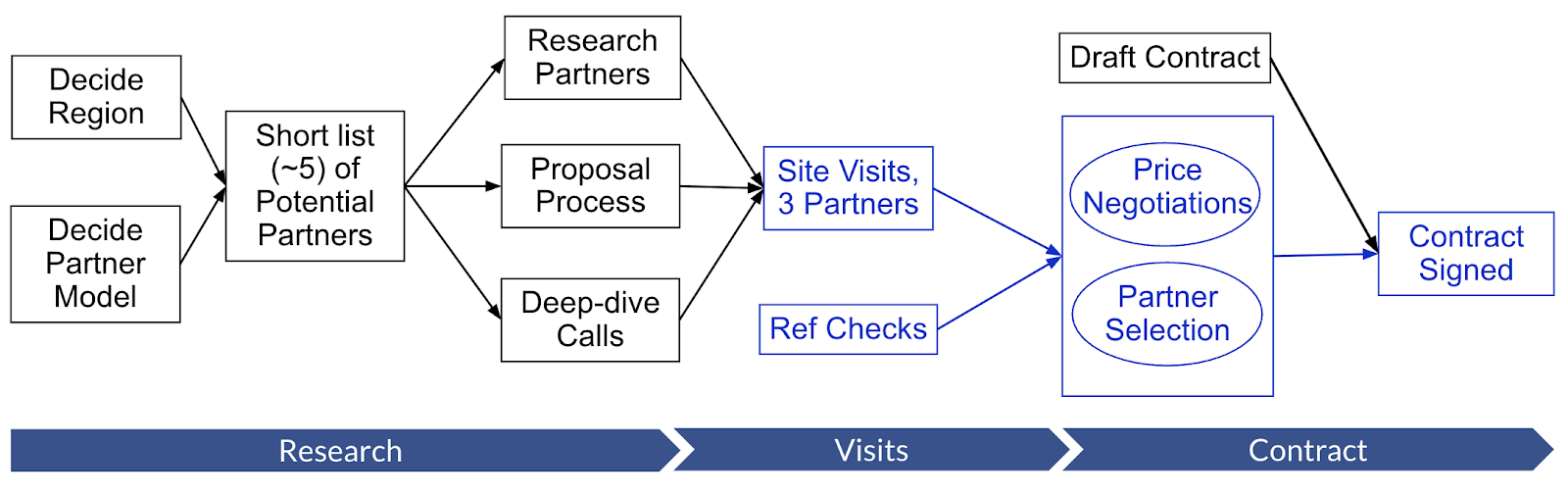
When evaluating candidate partners within a selected geography, move past generic marketing presentations and build an objective matrix focused on verifiable criteria:
- Talent Acquisition Pipeline: What is their proven yield rate for senior talent within your specific technology stack? What is their verified baseline attrition rate compared to the regional average?
- Cultural and Communication Alignment: Does their operating rhythm match your collaboration style? How do they evaluate communication skills, proactive problem-solving, and product engineering mindsets during their interview process?
- Operational Infrastructure: Do their data security controls, network redundancy protocols, physical hardware standards, and IP protection mechanisms satisfy your corporate compliance requirements?
- Commercial Framework Longevity: Is their pricing model transparently structured? Do their scale-up milestones and contractual exit mechanics protect your long-term flexibility?
6. Is the Infrastructure Ready to Support the Launch?
The final phase of expansion requires an honest assessment of your internal operational readiness. A nationwide or international team cannot succeed if it is deployed into a chaotic home environment. Before initiating the onboarding sequence, five operational prerequisites must be secured:
- Dedicated Financial Capital: Expansion funding must be fenced and guaranteed across a twelve-to-eighteen-month horizon. Pulling back capital mid-ramp destroys regional market reputation and disrupts development velocity.
- Executive Commitment: The leadership team must view the international center as a core strategic pillar, not a secondary experiments lab or a temporary cost-cutting measure.
- Calibrated Delivery Expectations: The organization must account for a predictable ramp-up curve. Expecting a distributed team to deliver complex features within their first thirty days introduces structural strain. Velocity requires a deliberate foundation of context transfer and architectural onboarding.
- Documented Context and Strategy: If your local team regularly struggles to understand the long-term product vision, a distributed team operating thousands of miles away will face total strategic isolation. Product documentation, architectural maps, and business strategies must be clear, accessible, and consistently updated.
- Operational Tooling Integrity: The digital environment must support seamless collaboration. Distributed builders require unified access to documentation engines, issue-tracking frameworks, testing environments, and automated continuous-integration loops. Forcing an international team to operate with degraded access to essential tools introduces friction that undermines their technical capabilities.
Move Forward with Intent and Diligence
Geographical expansion is not a quick fix for resource scarcity; it is a permanent structural commitment. Before opening a new center, hiring a partner, or moving a product line across borders, answer the six questions plainly:
- Why are we expanding geographically?
- How much separation are we introducing between customers, product, design, and engineering?
- Which parts of the portfolio are suited to this model?
- How much ownership and control do we need?
- What kind of partner, if any, can support the model we actually want?
- What must be true during ramp-up for the team to become part of the company rather than an appendage to it?
These questions will not eliminate the difficulty. They will make the difficulty visible early enough to design around it.
That is the work. Not simply finding talent in another location, but building an organization that can turn distributed talent into coherent product progress.