
AI has accelerated execution. A strategic product roadmap decides which customer problems deserve that speed.
The fastest way to build the wrong product in 2026 may be deciding that your team is moving too fast for a strategic roadmap.
That belief is understandable in an environment where: a) working prototypes can emerge in an afternoon, b) the Agile machinery runs cleanly and c) your AI infrastructure improves by the week. Engineers are shipping faster than product leaders can frame the next decision, creating the uncomfortable sense that product has become the bottleneck.
While speed has changed the economics of execution, it has done nothing to guarantee that the work deserves to be built. When almost any plausible idea can become software, more ideas make it through the front door. Each arrives with a reasonable story: a customer asked for it, a competitor launched something similar, a stakeholder sees revenue attached to it, or the demo looked impressive.
Those decisions accumulate into more surface area to maintain, more settings to explain, more edge cases to test, and more choices for customers to navigate. While no single decision looks reckless, six months later, the product reflects a stream of locally rational requests rather than a coherent strategic bet. This is AI-assisted feature sprawl dressed up as velocity.
Speed amplifies whatever sits upstream
Most companies still have an ambitious vision at the top and a meticulously managed backlog at the bottom. The space between them is thin or empty. The vision describes the future the company hopes to create. The backlog captures the work teams can do next. Neither explains which customer problems matter most over the coming year, where the company intends to place its larger bets, or how those investments form a credible path toward the vision.
Without that middle layer, the backlog becomes the operating strategy. The loudest stakeholder, the most urgent customer, and the most compelling prototype shape the product one sprint at a time. Teams remain busy and shipping metrics may look healthy. The probability that the work adds up to the company's stated direction becomes largely accidental. Speed simply gets the organization there faster.
A feature-driven roadmap preserves the same problem
Keeping a roadmap and filling it with features offers little protection. It gives the same drift a cleaner layout: a backlog with quarters across the top.
Feature roadmaps capture proposed solutions before the team has understood the opportunity. They become obsolete as discovery changes the approach, scope shifts during delivery, and new requests compete for visible slots. They also pull stakeholders into debates about preferred solutions while product teams inherit commitments made before value, feasibility, and business fit were explored.
A strategic roadmap operates one level higher. Its atomic unit is a problem or opportunity theme: a consequential customer need, benefit gap, or market opportunity that deserves coordinated attention. Features emerge later, through discovery and design, once the team has learned enough to choose among possible solutions.
Continuous discovery needs a strategic starting point
Continuous discovery is sometimes positioned as a replacement for roadmapping. That interpretation assigns discovery a different job from the one it performs best.
Foundational research reveals recurring needs, jobs to be done, pain patterns, behavioral shifts, and customer benefits that remain poorly served. Product strategy identifies the spaces where the company has a credible right to win. The roadmap selects and roughly sequences the most important problem themes. As a theme moves closer to execution, the product team begins deeper opportunity definition and continuous discovery: understanding the problem in context, testing assumptions, exploring solutions, and reducing risk.
Discovery evidence also flows back upward. It may weaken a roadmap assumption, uncover a more valuable adjacent problem, or show that a theme should move, shrink, or disappear during the next review. This is a learning loop. The roadmap provides strategic focus by deciding which themes deserve scarce discovery and development capacity; discovery earns and refines the solution.
The roadmap is the connective tissue between vision and execution. It explains how the company expects its ongoing investments to move customer outcomes and, over time, manifest the product vision.
What belongs on a strategic roadmap
The roadmap I am describing has little in common with a project Gantt chart. It is a roughly sequenced, continuously informed view of the major problems a product organization intends to solve. It has enough stability to guide investment and enough humility to evolve as evidence changes.
A strategic roadmap worth using has several defining characteristics:
- Grounded in foundational customer research and anchored in measurable customer benefits
- Owned by empowered product leaders who synthesize customer, business, and technical input, then make the tradeoffs
- Written as problem or opportunity themes, with features deferred until opportunity definition, discovery, and design
- Explicit about the resource capacity reserved for strategic themes, incremental enhancements, and product hardening
- Probabilistic about timing, with confidence communicated rather than hidden
- Visible and understandable across the organization, supported by a storyline that explains the reasoning behind key themes
The resource allocation point deserves special attention. Every product organization is already dividing its capacity among strategic themes, discrete feature enhancements, and bugs, technical debt, or product hardening. The allocation exists whether leaders discuss it or not. When it remains implicit, urgent requests tend to consume the space intended for strategic work. Teams finish the quarter having shipped a great deal while making little progress on the opportunities that could change their competitive position.
Before doing any roadmapping, reach agreement on how much resources will be focused on each of these three areas (strategic themes, discrete features, product hardening.) Just how much? That depends on your company stage and culture. There is no universal percentage for the strategic bucket. A young product with few customers can place a larger share of capacity on major bets. A mature enterprise product may need substantial capacity for contractual obligations and incremental improvements. The useful act is to decide, communicate, and measure the allocation. A declared target gives teams permission to protect important work from the firehose of smaller requests.
Start with the boulders
I use the boulder, rock, and pebble analogy when looking at the pool of product possibilities. Boulders are the large, 10X bets that could create a new capability, open a market, or materially change the customer experience. Rocks are other strategic themes that support the product strategy. Pebbles are the discrete enhancements that keep an existing product healthy and responsive.
The strategic roadmap contains boulders and some rocks. All pebbles belong in the backlog.
This separation improves both planning and execution. A roadmap crowded with dozens of small features becomes unreadable and expires quickly. It also encourages teams to apply the same process to every item. Major innovations carry unresolved customer, experience, business, and technical questions. They benefit from foundational research, opportunity framing, iterative concept work, and close collaboration among product, design, and engineering. A modest enhancement usually just needs a crisp problem statement, a straightforward design, and competent delivery. One deserves a carpentry studio; the other may need a hammer.
Product organizations often overinvest in pebbles because each one has an advocate and a visible near-term benefit. Boulders are easier to postpone. Their value is larger, their uncertainty is higher, and their constituency may not exist yet. A strategic roadmap makes that trade visible before the quarter is consumed by requests that felt individually reasonable.
A roadmap is the output of a decision process
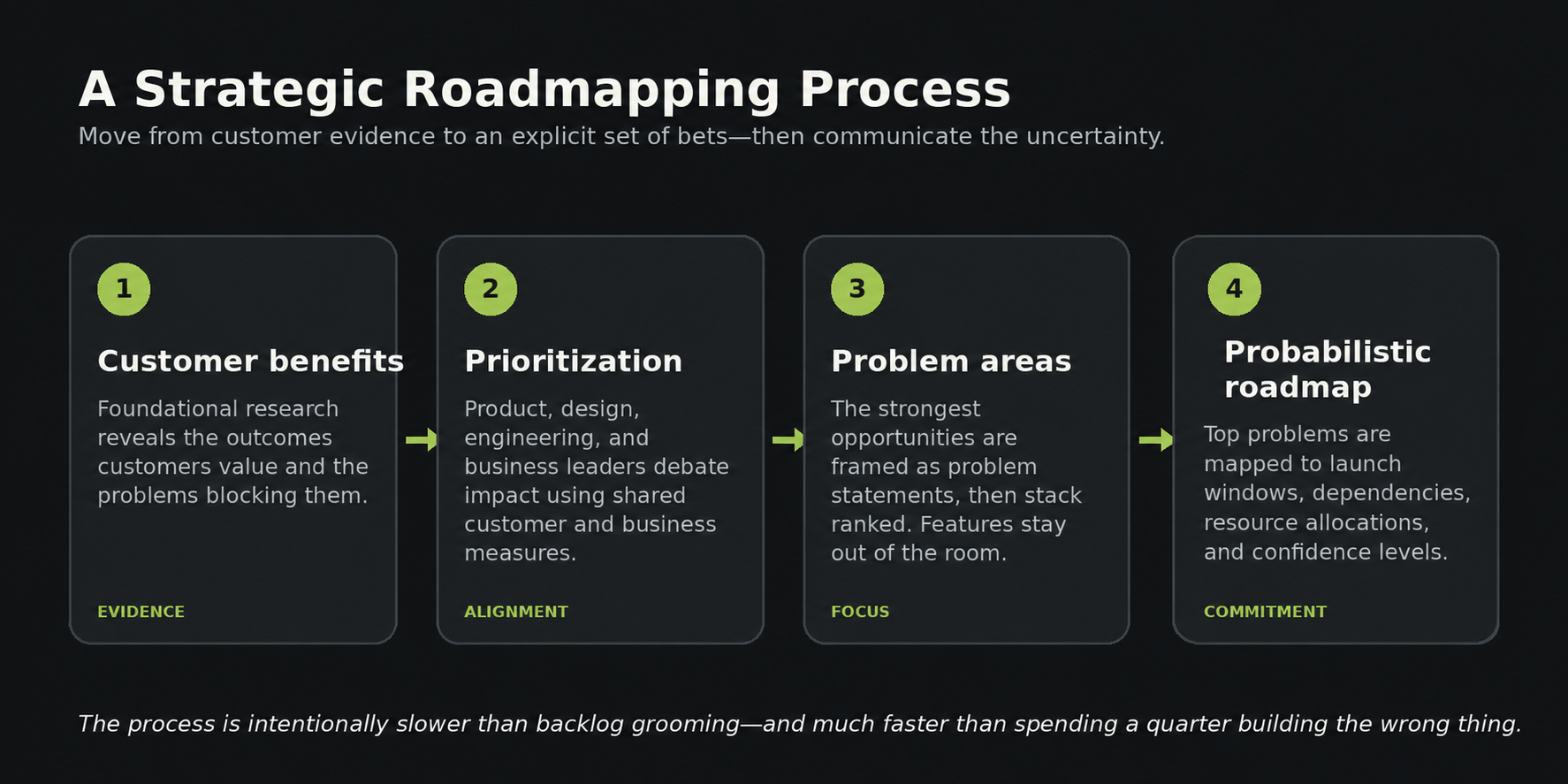
A roadmap should emerge from customer evidence and deliberate prioritization. Starting with a blank timeline and asking executives what they want to see in each quarter produces a negotiation artifact with little strategic value.
Begin by assembling the full set of credible strategic opportunities. Foundational research, customer benefit measures, product analytics, competitive shifts, technical opportunities, and recurring themes from customer-facing teams all contribute. Even feature requests can be useful raw material. Work backward from each request to uncover the underlying problem. "Add real-time order tracking" is a proposed solution. "Customers lose confidence after checkout because they cannot see the status of an order" is a problem area that leaves room for better solutions.
Before the prioritization session, decide how you will decide. Select a small number of customer outcomes and business measures that reflect the product strategy. A workshop with ten or fifteen problem-oriented themes and a few agreed evaluation criteria creates a much better discussion than a room trying to vote on seventy features. Participants can debate how strongly each theme would affect a customer benefit, what evidence supports the claim, what capabilities it requires, and which dependencies could change the sequence.
Use color rather than numeric scores during this evaluation. Numbers create a false sense of precision and invite arguments about minor differences that the evidence cannot support. Color keeps the exercise honest: this is a well-informed, qualitative synthesis of customer evidence, business context, and the experience in the room.
Color is a risk language
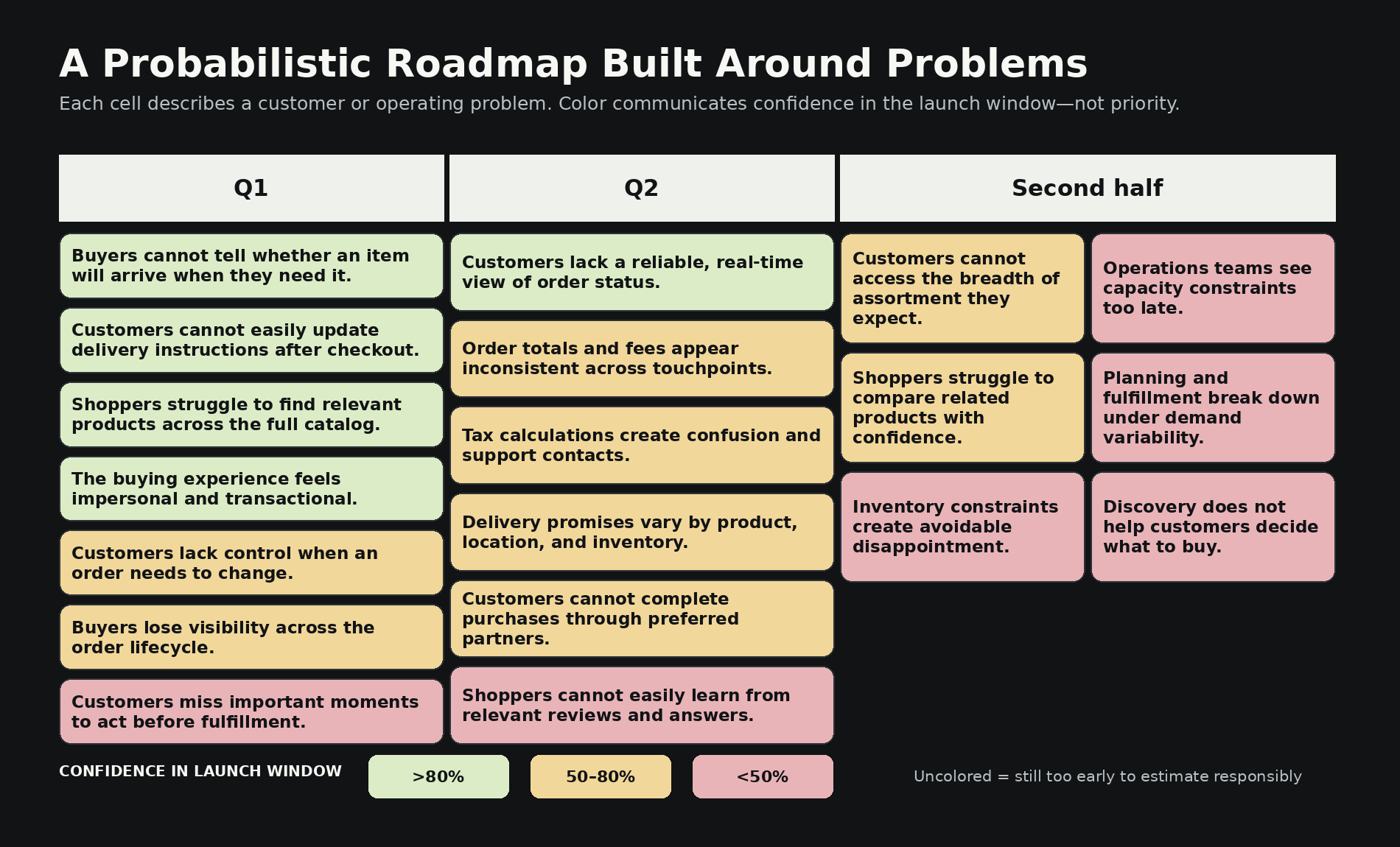
One small change makes a roadmap far more credible: use color to communicate confidence.
Any roadmap that looks into the future contains assumptions about scope, dependencies, team capacity, technical feasibility, and what will be learned during discovery. A plain grid of themes and quarters hides those assumptions. Some readers will interpret every cell as a commitment. Others will apply their own private discount rate. Two people can leave the same presentation with different beliefs about what is likely to ship.
Color creates a shared language. Green indicates more than an 80 percent confidence that a problem area will produce a meaningful launch in the stated window. Yellow indicates a 50 to 80 percent range. Red for less than 50 percent.
These ranges are directional judgments about planning confidence. They expose uncertainty and prompt a useful conversation about its source. A red item may be the most strategically important theme on the roadmap. Its color describes confidence in the launch window; strategic importance is a separate dimension.
The roadmap should show launch windows. Detailed project timelines belong in the discovery and delivery plans for work already underway. A problem area shown in the fourth quarter may require research and design work in the second and third quarters. That internal activity belongs in the plans used by the teams doing the work. The strategic roadmap communicates when the company expects the theme to create value in the market.
Once color is added, the roadmap stops making one uniform promise about a future composed of very different levels of knowledge. Near-term areas tend to carry higher confidence because teams understand the scope and dependencies. The picture becomes fuzzier as it extends outward. That is an honest representation of planning, and the honesty increases the roadmap's usefulness.
Semi-rigid by design
A strategic roadmap should change, just on a different cadence from the backlog. Daily and weekly refinement belongs in product discovery and delivery. The strategic layer needs enough stability for teams to coordinate, protect capacity, and finish meaningful work.
For most software products, a roughly one-year horizon is sufficient. Beyond that point, the number of assumptions grows and the discussion belongs in product vision, product-line strategy, and longer-term investment horizons. Rebuild the roadmap more substantially once a year, often alongside fiscal planning, and conduct a lighter review each quarter. The quarterly cycle is a good time to remove completed themes, move items whose assumptions have changed, and add new problem areas supported by customer learning.
Constantly editing the roadmap creates its own cost. Every change affects team plans, stakeholder expectations, sales conversations, and the supporting narrative. A roadmap that changes weekly is usually a backlog wearing a suit. Problem-oriented themes are durable enough to absorb changes in solution direction without forcing the entire strategic artifact to be rewritten.
The matrix still needs a story
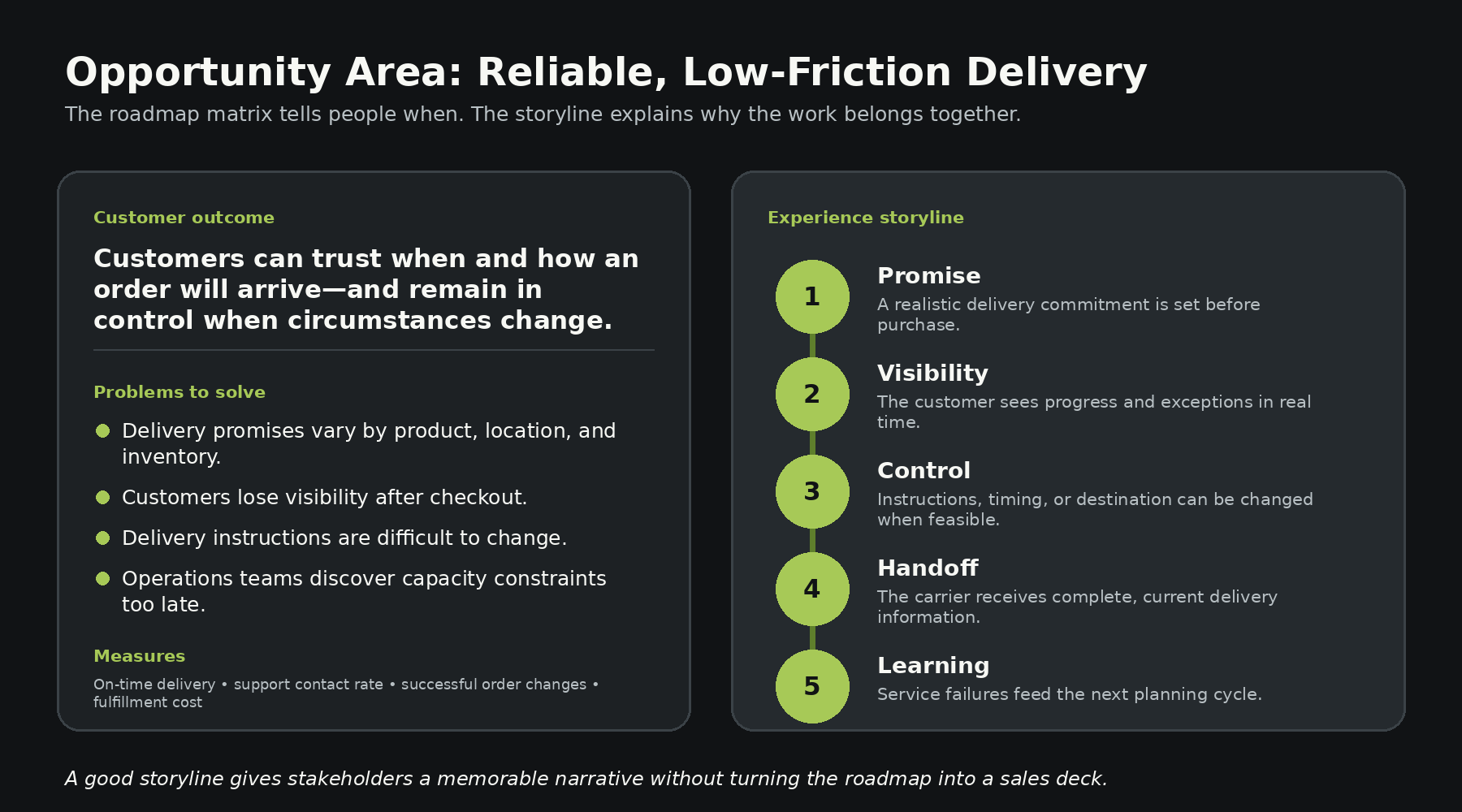
A useful roadmap matrix is usually plain by design. It should convey the greatest amount of information in a compact, maintainable format. The downside is that a matrix does a poor job of explaining why several themes belong together or what experience the organization is trying to create.
Pair the roadmap with a short storyline. For each major opportunity area, explain the customer outcome, the problems that currently prevent it, the measures that should move, and the broad experience the company intends to enable. A few conceptual visuals can help people remember the direction without locking the team into a premature solution.
Lead with that story when presenting the roadmap and end with the matrix that adds sequencing and confidence. Stakeholders will remember the customer problem and intended outcome longer than they will remember which colored cell sat in which quarter. The matrix is the operational receipt. The story is what people carry into their own decisions.
Use AI efficiency to improve the bet
The best AI-related news for product strategy is that some of the time previously consumed by execution can now move upstream. Teams can analyze research faster, explore a broader solution space, build prototypes that customers can react to, test technical approaches earlier, and keep strategic artifacts current with less administrative work.
That capacity is most valuable when it improves the quality of product decisions instead of simply increasing feature volume. Use it to improve the probability that the larger bets are worth making. Spend more time understanding the customer need, defining the opportunity, pressure-testing the value proposition, and exposing the assumptions that make a theme risky. Then use the faster build system to learn and deliver.
The AI era rewards companies that combine speed with selection. A team that ships ten times faster while pursuing low-value work reaches feature bloat sooner. A team that identifies a consequential problem, protects capacity around it, communicates its uncertainty, and learns quickly has a plausible path to category leadership.
Build fast. Make the decision to build the hard part.
Author's note: This article is adapted from Product at a Distance: Software Innovation in the Era of Distributed Teams. Available for purchase here.