
We have a measurement problem in software engineering.
If you walk into almost any product organization today and ask how they measure progress, they'll show you a burn-down chart. They'll talk about story points. They'll tell you their velocity is up 15% over last quarter. On paper, the machine is humming. The engineers are busy, the tickets are moving, and the "output" is undeniable.
But here is the hard truth: Story points do not measure impact.
Most software teams eventually develop a healthy obsession with output velocity. You can have a team with world-class velocity that is effectively sprinting toward a cliff. You can ship fifty features that no one uses, hitting every sprint goal along the way, and still fail to move the needle for the business. If your engineering culture is built entirely around "clearing the queue," you aren't running a product team—you're running a ticket factory.
To build products that matter, we have to stop obsessive-tracking of effort and start measuring Value Velocity.
The Burden of Output
Output is easy to measure. It's quantifiable, it's objective, and it makes people feel productive. This is why story points are so addictive. They help a new team form habits and provide a baseline for capacity.
However, for your work to have a lasting impact, outcomes matter more than output. In my work with various product organizations, I've found that even the most talented engineering teams struggle to connect their daily coding tasks to the company's bottom line. They are often insulated from the "why" behind the "what." This insulation creates a disconnect where "success" is defined by closing a Jira ticket rather than solving a customer problem.
If you want to reorient your team toward impact, you need a different yardstick. You need a system that tracks the delivery of value against your strategic roadmap.
Introducing Value Velocity
Value Velocity is a framework designed to bridge the gap between engineering effort and business strategy. It's an accounting exercise that forces the organization to stop looking at how hard they are working and start looking at what that work is actually worth.
The system relies on three pillars: a well-aligned roadmap, a standardized value scale, and a disciplined "value accounting" cycle.
1. The Roadmap as the Yardstick
You cannot measure value in a vacuum. You need an established, stakeholder-aligned mid-term view of desired outcomes. This is typically a one-year product portfolio roadmap that outlines the strategic themes driving value for your customers and your business.
This roadmap shouldn't be a list of features; it should be a list of strategic themes. This document is your ultimate yardstick. Before you can measure value velocity, everyone in your extended organization (business unit for larger enterprises; entire company for small to medium organizations) must agree that this roadmap represents the highest-value path forward. The rest of this article assumes that you have some form of a themed, outcome-based roadmap to work from. If not, that is your first order of business (I will cover this topic in a separate forthcoming article.)
2. The 4-Point Value Scale
Before a quarter begins, you must assign a numerical value to each strategic theme. Crucially, this is not a measure of the effort required. It is a measure of the value that will accrue to the business and the customer once that theme is launched. If you used value points to prioritize your roadmap at the beginning of your fiscal year, you likely already have a solid version of theme values.
Otherwise, assign value points before the current quarter begins. The value should be assigned by the product lead, then reviewed and vetted by the head of product and key business stakeholders. I recommend using a four-point scale to keep things simple and avoid the "weighted average" trap:
- 1 Point: Tactical Features. These are small improvements with limited adoption potential or minor strategic impact. They are necessary "keep the lights on" or "polish" items.
- 2 Points: Medium Value. Functional improvements that move the needle but don't redefine the product.
- 3 Points: High Value. Functional improvements that provide meaningful value to a large percentage of your customer base. This is the "meat" of your roadmap.
- 5 Points: Major Strategic Impact. These are your big bets. These heavy hitting themes have an outsized impact on the company's core mission and have potential to provide massive customer value.
By using this scale, you are explicitly stating that one "Level 5" theme is worth more to the company than a handful of "Level 1" tasks. It forces a conversation about priority that story points never do.
3. The Quarterly Retro (Value Accounting)
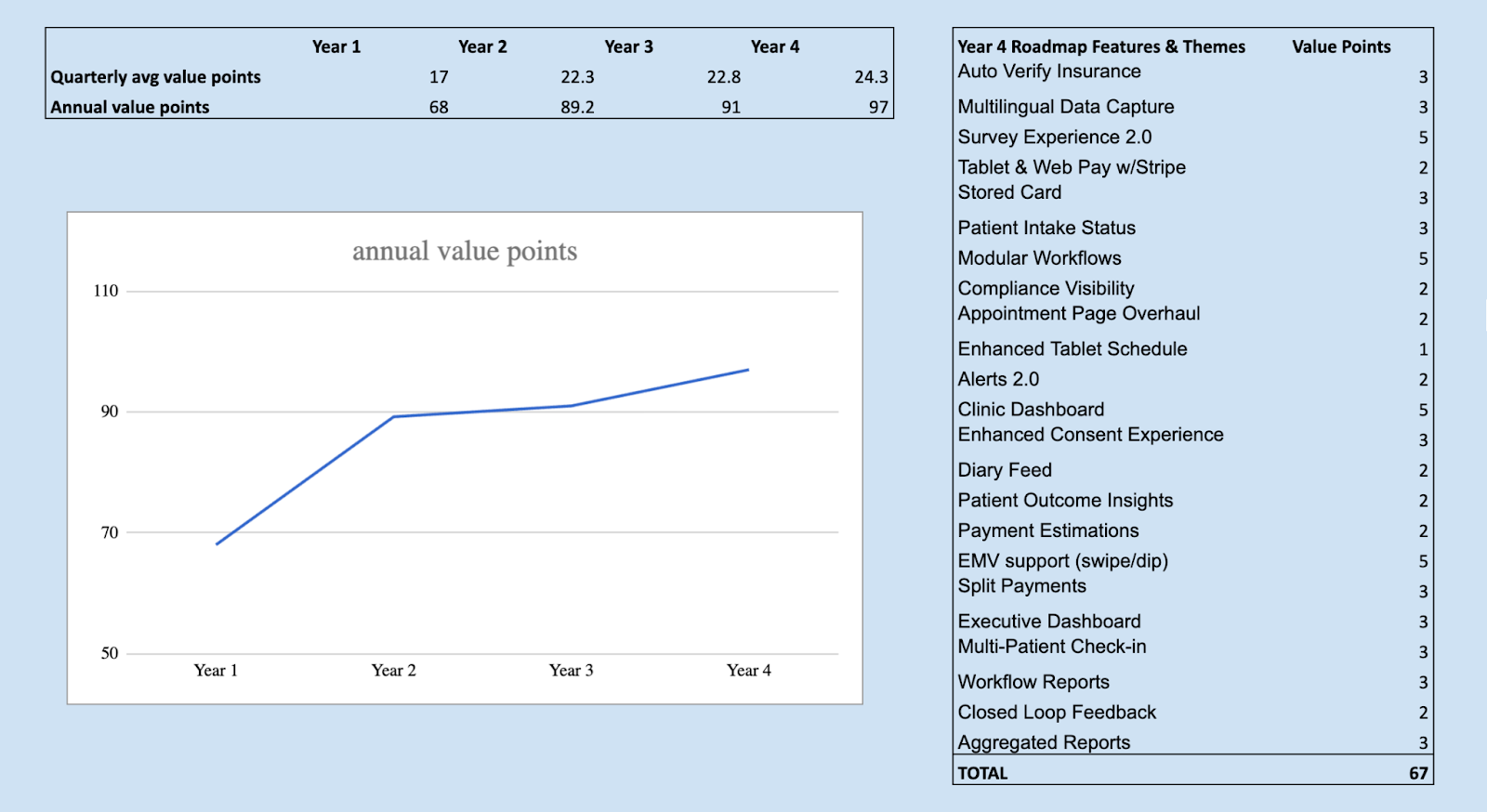
At the close of every quarter, you perform a "value retro." This is a quick accounting exercise which usually takes less than an hour and accounts for all themes that went live, those that were postponed, and any new themes introduced.
You tally the value points launched in that quarter and compare them to the expected value points from the roadmap you established at the start of the year.
This is your Value Velocity.
It answers the only question that actually matters: Did we deliver the value we promised to the business?
Solving the "Partial Delivery" Problem
One of the most common challenges in this system occurs when a large theme is partially delivered. Perhaps you shipped the first phase of a major migration that adds immediate value, but the rest of the work extends into the next quarter.
My advice: Defer recognition of the full value until the work is complete. If you start splitting value points across quarters (e.g., "We delivered half of a 3-value-point task"), you open the door to "gaming" the system. It's a slippery slope toward making the data look better than reality. Be disciplined. Value is only realized when your customer can actually use the solution.
The Secret Sauce: Skin in the Game
If you want this to be more than just another management dashboard, you have to create "skin in the game."
In my experience, the single most effective way to reorient engineers away from a "ticket factory" mindset is to tie bonuses to the percentage of value delivered versus expected.
It sounds blunt, but money motivates. When an engineer's financial upside is tied to the value achieved rather than story points delivered or the number of tickets closed, their perspective shifts overnight. Suddenly, they care deeply about why a project is delayed. They start to gravitate towards solving the gnarly problems. And they become invested in a roadmap's accuracy. They start asking, "Is this the most valuable thing I could be working on right now?"
This alignment creates a culture of ownership. It turns engineers into business partners.
Celebration and Learning
Finally, don't treat Value Velocity as a purely clinical exercise. At the end of each quarter and year, hold a ceremony.
These meetings (usually 60 to 90 minutes) should be a mix of celebration and a "post-mortem" on your strategy. If you delivered 110% of your expected value, celebrate the win. If you only delivered 60%, don't just look for who to blame—look for the "why."
- Did we over-estimate our capacity?
- Did we pivot too many times?
- Did we assign points to the wrong things?
- Did we chase too many incremental features, avoiding the harder, higher value work?
The goal isn't just to track a number; it's to build a more predictable, high-impact organization.
Stop Counting, Start Weighing
High output is great, but high outcome is the goal. If you are tired of seeing "100% sprint completion" on your reports while your product remains stagnant in the market, it's time to change how you measure success.
Stop solely counting story points and start weighing value. Your team, your stakeholders, and your customers will thank you.