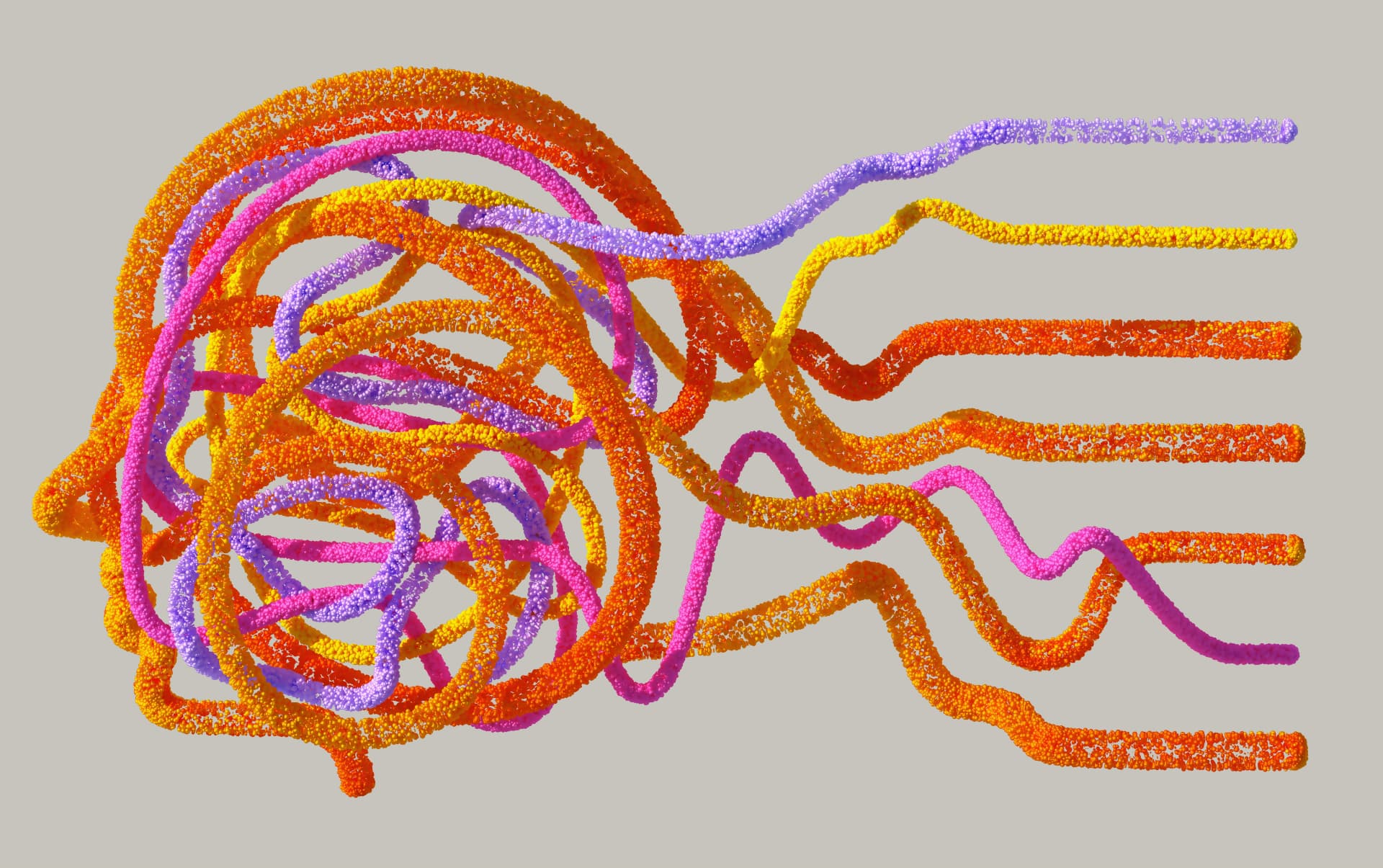
Neuroscience suggests the brain has no decision-making system at all. Many product organizations don't have one either.
Have you ever participated in a roadmapping workshop where the outcome felt pre-determined before anyone spoke? Or a strategy meeting that took two hours to formally bless something three people had already agreed to over Slack the week before?
That feeling … that the meeting was theater, that the real decision happened somewhere else, earlier, in pieces too small to notice at the time … turns out to have a name in neuroscience, and a stranger explanation than "politics" or "pre-alignment."
There is no decider in there
A paper published in the Journal of Cognitive Neuroscience this August, by Indiana University psychologist Thomas James, argues that the brain doesn't actually contain a decision-making system at all. Not a weak or inefficient one. Just none at all. The conventional model of how choice works, which James calls the "sandwich model," assumes a clean sequence: you perceive something, you think about it, you decide, then you act. Decision sits in the middle, a discrete step between thinking and doing. James's argument is that neuroscience doesn't actually support that sandwich. What we experience as a decision is a high-level description of behavior already shaped by perception, movement, and environment acting together instead of a physical event that causes the behavior (closer to a story told about the behavior after the coordination already happened.)
He makes the point with an analogy borrowed from physics. A body's center of mass is a genuinely useful concept: you can calculate it, use it to predict how something will move — but it isn't a physical thing sitting inside the object, pushing it around. Decisions, in James's model, work the same way. Useful as a description but not a mechanism. And when researchers have gone looking for the mechanism, for a specific place in the brain where perception ends and decision begins, what they keep running into instead is philosopher Daniel Dennett's old warning about the "Cartesian Theater", which is the temptation to imagine a little person inside your head, watching the inputs and issuing the verdict. There's no one in there. There's a lot of coordinated activity that, from the outside, looks like someone made a call.
James backs the argument with something simple: a robot with sensors and motors, no decision-making module of any kind, that follows a wall as if it were choosing its path. It's responding, continuously, to what its sensors pick up. The wall-following looks intentional from the outside. But what's actually happening is a pattern that emerges from many small, ongoing responses to the environment, with no single moment in the system that deserves the name "decision."
Where the actual shaping happens
I don't think this maps onto product organizations by accident. Sit through enough roadmap reviews and you'll notice the same gap between what the meeting is supposed to be and what it actually is: perceive the market, think it through, decide, then build. In an organization without solid upstream layers — a shared destination, a narrow set of bets, a clear definition of customer value — that gap is where the roadmap actually gets set, and it's set by whatever happens to be loudest in the room. Which customer call got repeated enough in Slack to start feeling like a pattern. Which engineer's offhand estimate made one option look cheap. Which slide got reused from last quarter because nobody had time to build a new one. Which stakeholder caught the CEO in the hallway first. None of that is anyone acting in bad faith, and none of it looks like a decision while it's happening. But without something upstream to filter it, that's what ends up shaping the roadmap — and the review just narrates the result and calls it deliberate.
Building the upstream
If those small, easy-to-miss moments are what actually shape the roadmap, the fix isn't a sharper two-hour review. It's giving those moments something solid to run into before they harden into a plan. That's essentially the job of the Decide floor in my book, Product at a Distance. James's paper is the first thing I've read that gives a neurological account of why that floor needs to exist at all.
A product northstar gives those hundred small judgment calls a shared direction to lean toward: which customer story feels worth repeating, which slide gets pulled forward … without anyone having to consciously coordinate it in the moment. Product line strategy narrows "what could we build" down to the few big bets that actually matter, so a stray idea from a hallway conversation doesn't get to relitigate the whole roadmap. And Customer Benefit Metrics go furthest: when roadmap themes are bound to a specific, shared definition of customer value, an offhand estimate or a hallway ask gets filtered through the same question before it ever reaches a review room — does this move a benefit metric, or doesn't it? None of this is a governance process bolted onto the decision after the fact. It's upstream architecture, built so the small distributed moments are already leaning the right way by the time anyone convenes a meeting to "decide."
Build that upstream well, and the review stops being purely theater. I walk through how to actually build all three — northstar vision, product line strategy, and Customer Benefit Metrics — in the Decide chapters of Product at a Distance, including the workshop mechanics for each. Available for purchase here.
Closing thought
Product orgs like to believe there's a single moment where thinking becomes choosing becomes action — clean, traceable, with someone's name attached to it. Neuroscience is increasingly suggesting that's not how decisions work in a single human brain, let alone across a hundred people spread over three time zones. That's not a discouraging finding once you really ponder it. It just relocates the work. Stop trying to perfect the room where the roadmap gets announced, and start building the upstream conditions — the shared destination, the narrowed bets, the metrics tied to real customer benefit — that subtly (and not so subtly) decide it long before anyone walks in.
Sources: Thomas W. James, "Sensorimotor Mechanisms of Decisions and Actions," Journal of Cognitive Neuroscience 38(6): 1089 (2026); ScienceDaily summary, August 23, 2026.